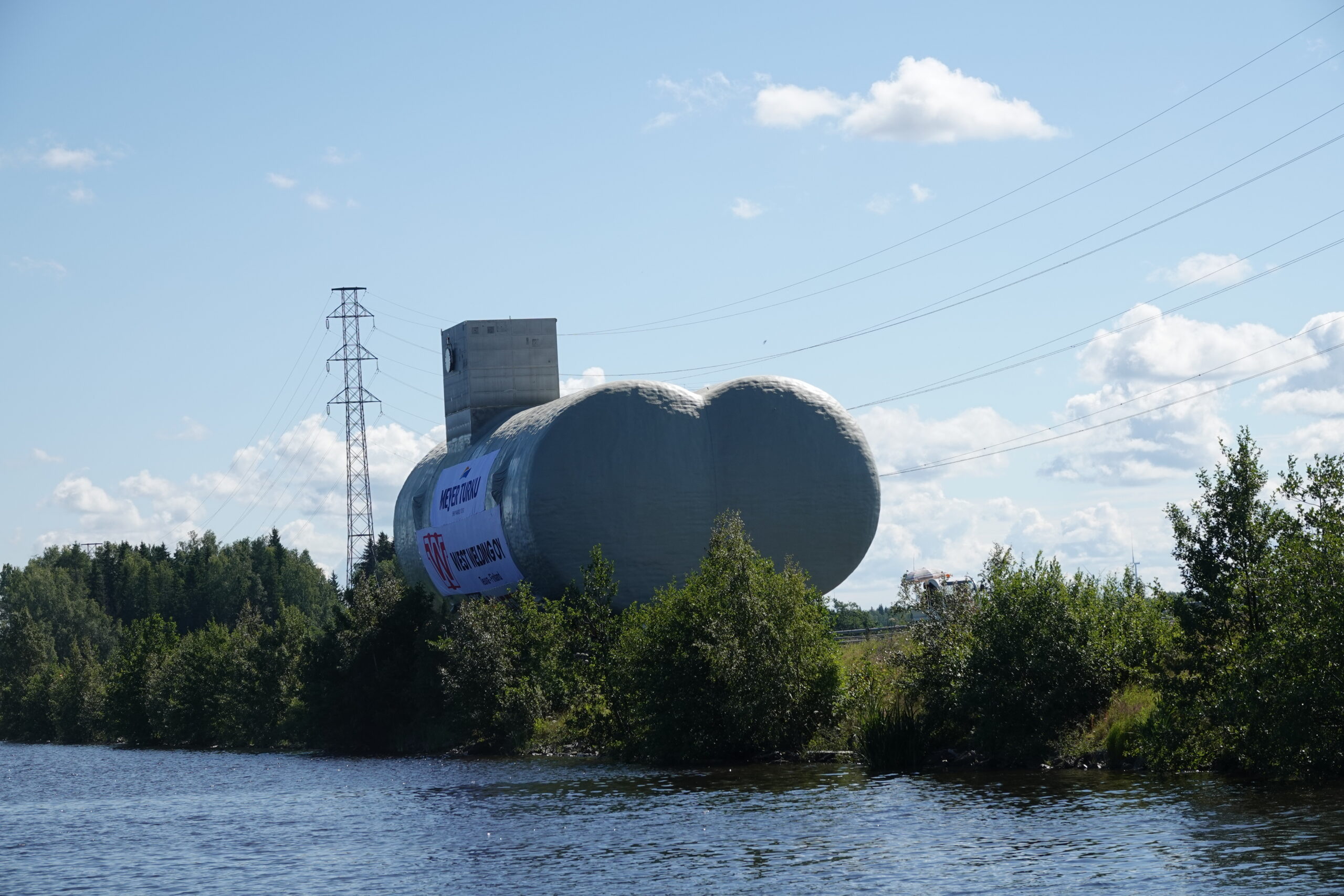
LNG technology has established its position as an integral part of modern shipbuilding, and the requirements placed on tank solutions continue to grow. In particular, large-scale bilobe Type C LNG tanks are technically demanding systems where engineering, manufacturing, cryogenic insulation, and logistics form one integrated delivery project.
In demanding marine industry projects, success is not determined by a single phase. What matters is the management of the entire delivery chain, from design to final delivery. When critical phases are executed within the same supply chain, interface risks can be reduced, schedule control improved, and project execution ensured according to plan.
Project Scope
The project involved the manufacture and delivery of two LNG tanks to Meyer Turku for an ICON-class cruise ship.
Project Facts
- Number of tanks: 2
- Tank type: Type C LNG tank
- Configuration: Bilobe
- Application: LNG fuel tank for a cruise vessel
- Weight: Over 300 tonnes per tank
LNG Tank Engineering and Design Forms the Foundation of the Project
The design of Type C tanks must account for both the mechanical loads encountered in marine service and cryogenic operating conditions.
LNG is stored at approximately -163°C, placing special requirements on material selection, structural design, and welding solutions. The tank design also defines inspection requirements, key manufacturing stages, and the integration of the tank into the vessel’s fuel system.
The bilobe configuration enables high storage capacity while making efficient use of the available onboard space. However, the design also introduces additional manufacturing challenges, as dimensional accuracy must be maintained throughout the production process.
During engineering and design verification, multiple load cases that the vessel may encounter throughout its service life must be considered. Vessel motions create significant accelerations and corresponding forces acting on the tank structure. As a result, fatigue assessments of both the tank and its welded joints are required to ensure that the tank maintains its integrity throughout its operational lifetime.
LNG Tank Manufacturing Requires Heavy Production Capacity
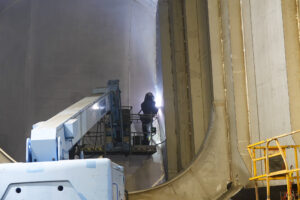
The manufacturing of a large bilobe LNG tank involves far more than assembling steel structures. Plate processing, forming, assembly, and welding create a complex production process in which each stage affects the next. In pressure vessels designed for cryogenic service, the importance of welding is particularly significant. Structures must retain their mechanical properties at extremely low temperatures while meeting the requirements of shipbuilding regulations and classification societies.
During manufacturing, every critical operation is documented, inspected, and verified as part of the quality assurance process. Fatigue loading caused by vessel motions places demanding requirements on weld quality. Defect-free welds are verified through both volumetric inspection methods (RT/UT) and surface examination methods (PT).
For pressure-retaining welds, the volumetric inspection coverage is 100%. This is typically supplemented with 10% surface examination, although in the most critical areas the surface inspection requirement may be increased to 100%. These procedures ensure that the completed LNG tank fulfills all technical requirements before progressing to the next phase of the project.
Cryogenic Insulation Is an Essential Part of LNG Tank Performance
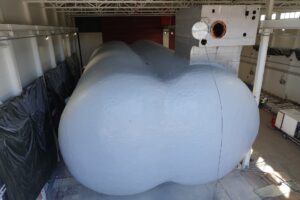
Following manufacturing, the tank proceeds to the cryogenic insulation phase.
LNG is stored at approximately -163°C, meaning that the temperature difference between the inside and outside of the tank can exceed 180 degrees Celsius. The purpose of the insulation system is to minimize heat ingress and control LNG boil-off throughout the service life of the tank.
Cryogenic insulation differs significantly from conventional industrial insulation. The solution must combine low thermal conductivity, moisture management, fire safety, and the ability to accommodate thermal contraction as the tank cools down to its operating temperature.
In marine applications, insulation is an essential part of LNG fuel system performance. It helps manage heat ingress and the natural boil-off of LNG while ensuring the safe and energy-efficient operation of the fuel system throughout the vessel’s lifetime.
Heavy Haul Transportation Requires Carreful Planning
Once the LNG tank, weighing more than 300 tonnes, was completed, the most visible phase of the project began: heavy transport.
Including transport structures and specialized transport equipment, the load measured approximately 15 metres in width, 14 metres in height, and had a total weight of approximately 500 tonnes.
Transportation from Teuva to the Port of Kaskinen was carried out using two parallel remotely operated self-propelled modular transporters (SPMTs) equipped with a total of 144 wheels.
This was not a conventional transport operation but a complex logistics project, the preparation of which began well before the actual move. Route load capacity, junction geometry, power lines, traffic arrangements, and port operations all imposed specific constraints on the project. The transport route was prepared over a period of nearly one year and required road modifications, intersection adjustments, and infrastructure work involving power transmission lines.
The heavy transport operation demonstrated how logistics forms an integral part of large LNG tank projects and is as critical to project success as engineering and manufacturing.
Careful planning reduced delivery risks and ensured that the tanks reached the port according to schedule. In large shipbuilding projects, delays involving a major component can affect numerous downstream activities, making logistics an important contributor to overall project success.
One Supply Chain, Multiple Key Phases
The delivery of a bilobe Type C LNG tank consists of several interconnected phases. Engineering decisions influence manufacturing, manufacturing creates the conditions for insulation, and logistics ultimately ensures that the completed tank reaches the customer safely and on schedule.For this reason, the successful execution of large LNG tank projects requires expertise across engineering, manufacturing, cryogenic solutions, and demanding heavy transportation operations.
West Welding’s LNG expertise covers both marine LNG fuel systems and onshore LNG infrastructure. Experience in LNG storage, transfer, and handling helps ensure that, in addition to tank design, the requirements of system integration are also considered already during the engineering phase.